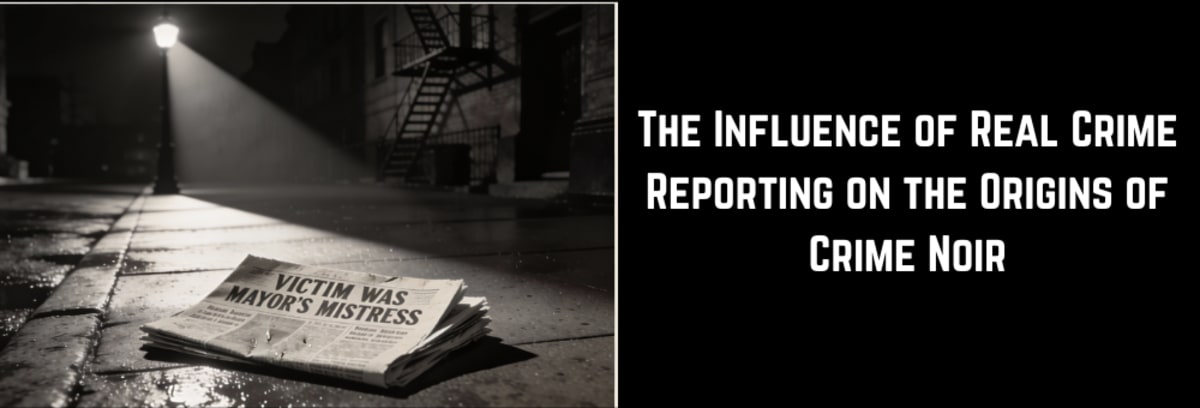
By the early twentieth century, crime had become a public narrative. Newspapers no longer treated murders, robberies, and corruption as isolated incidents. They were serialized, contextualized, and dramatized, often unfolding over weeks or months. Readers followed trials, appeals, confessions, and executions as continuing stories. This shift transformed crime from an aberration into a social condition—one that noir would later assume as its baseline reality.
At the heart of this influence lies realism, but not the sanitized realism of official statements or civic boosterism. Crime reporting dealt in facts stripped of comfort. Victims were not symbols. Criminals were not monsters in the abstract. They were neighbors, coworkers, veterans, spouses—often ordinary people who crossed a line under pressure. Noir inherited this refusal to mythologize. Its criminals are rarely exotic; they are familiar, desperate, or banal. Its violence is not operatic. It is blunt, clumsy, and final.
Early crime reporting also introduced a narrative voice that noir would adopt almost wholesale. Journalists wrote with economy because space was limited and attention fleeting. Description was functional. Adjectives were chosen for impact rather than beauty. Sentences were short, declarative, and unadorned. When opinion crept in, it was often cynical, weary, or morally ambiguous. This style mirrored the psychological state of readers living through industrialization, urban crowding, economic instability, and later, global war. Noir prose echoes this journalistic restraint. It tells rather than explains, shows rather than reassures.
More importantly, crime reporting accustomed readers to moral uncertainty. Newspapers did not provide clear heroes. Police were sometimes incompetent, sometimes brutal, sometimes corrupt. Judges were political animals. Witnesses lied. Evidence vanished. Verdicts disappointed. Even when justice was served, it often felt incomplete or arbitrary. Crime noir absorbed this skepticism wholesale. In noir fiction, the legal system exists, but faith in it does not. Justice becomes a personal calculus rather than a public guarantee.
The influence of real crime reporting is especially visible in noir’s fixation on process. Reports lingered on investigative steps: interviews conducted, evidence gathered, timelines reconstructed. The mechanics of crime mattered as much as the crime itself. Noir fiction mirrors this procedural obsession, not to celebrate rational order, but to expose its limits. Detectives follow leads that dead-end. Clues mislead. Truth emerges slowly, often accidentally, and sometimes too late to matter. This structural inheritance gives noir its distinctive pacing—methodical but tense, grounded but unstable.
Language, too, bears the imprint of journalism. Crime reporting introduced street slang, police jargon, and courtroom terminology into popular reading. These were not literary affectations; they were functional vocabulary meant to describe reality as it was spoken and lived. Noir writers retained this diction because it sounded true. Dialogue in noir rarely feels polished or theatrical. It snaps, evades, and bruises. Characters speak like people who have something to hide or something to lose. This linguistic authenticity traces directly back to the newsroom.
Another critical influence lies in the way crime reporting framed motive. Rather than relying on melodramatic evil, journalists emphasized circumstances: money troubles, romantic entanglements, addiction, resentment, fear. Crime was contextualized within economic and emotional pressures. Noir fiction adopts this causal framework. Characters commit crimes not because they are villains, but because they are cornered. Desire and desperation replace grand ideology. This grounding in motive lends noir its tragic undertone. Characters are not doomed by fate alone, but by the accumulation of small, human choices.
Crime reporting also shaped noir’s treatment of violence itself. Newspapers could not romanticize brutality; they had to describe its consequences. Bodies were found broken, burned, or bloated. Survivors carried injuries that did not vanish by the next chapter. This realism stripped violence of glamour. Noir fiction follows suit. Violence in noir is sudden, ugly, and often anticlimactic. It solves nothing cleanly. It leaves scars—physical, psychological, moral. This approach distinguishes noir sharply from adventure fiction or later action genres.
The courtroom drama provided another template. Reporters chronicled trials with attention to testimony, contradiction, and performance. Truth became something argued rather than revealed. Noir inherits this adversarial conception of truth. Interrogations resemble cross-examinations. Conversations are layered with implication and misdirection. Everyone is presenting a version of events, and the protagonist must decide which lies are useful and which are fatal. The result is a genre deeply concerned with perception rather than certainty.
Equally important is what crime reporting normalized: repetition. Crime did not end. One murder replaced another. Corruption resurfaced under new names. This cyclical quality eroded the idea of progress. Noir internalizes this repetition. Solving a case does not fix the city. Removing one criminal reveals another beneath. The world of noir resets not to harmony, but to baseline dysfunction. This is not nihilism; it is observational honesty inherited from decades of headlines that promised reform and delivered recurrence.
Crime reporting also blurred the boundary between public and private life. Scandals exposed affairs, finances, addictions, and family secrets. The idea that privacy was fragile—and often illusory—became common knowledge. Noir fiction thrives on this erosion. Characters are rarely allowed to keep their secrets intact. The past intrudes. Hidden relationships surface. Lives unravel under scrutiny. The city itself becomes a surveillance mechanism, echoing the reporter’s gaze.
By grounding itself in the language and worldview of real crime reporting, noir achieved something rare: it felt honest in a dishonest world. Readers recognized its tone because they had already absorbed it with their morning paper. The genre’s enduring power lies in this lineage. Noir does not offer escape from reality. It offers recognition. And that recognition, forged in headlines and police blotters, remains its sharpest weapon.